
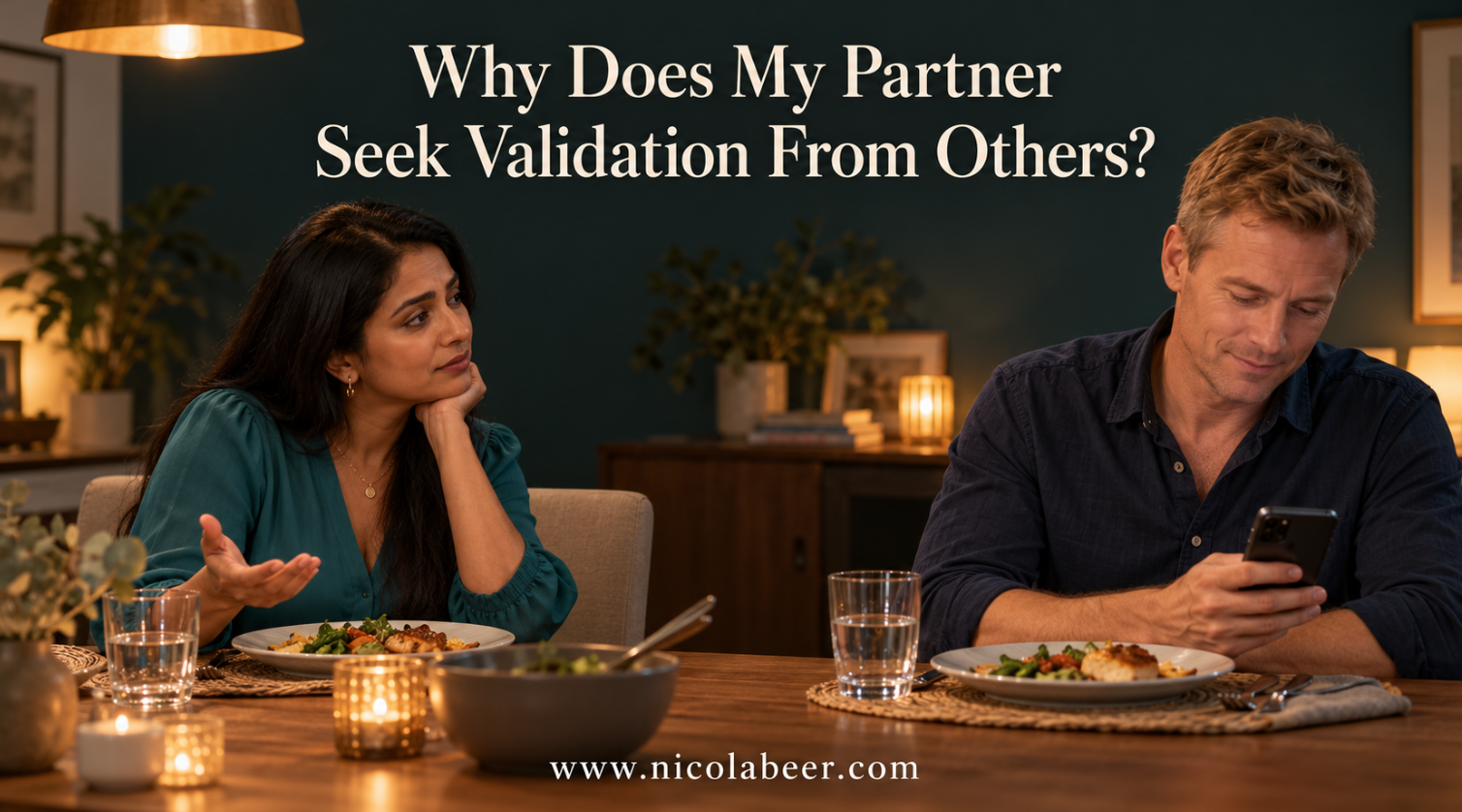
Why Does My Partner Seek Validation From Others When I Give Them Attention?
Why Does My Partner Seek Validation From Others When I Give Them Attention?
“I’ve caught him sexting twice. He says he likes the validation, but I give him attention. Why isn’t that enough?”
Perhaps you recognise that feeling.
You compliment your partner. You show affection, support their ambitions and make an effort to help them feel loved. Yet they still seem hungry for approval—from colleagues, strangers online or someone whose messages they have started hiding.
You may notice the same pattern at work. Praise lifts their mood, while being overlooked leaves them unsettled. They seem to need other people to confirm that they are successful, attractive or important.
When that need extends into flirting or sexting, it becomes deeply personal.
You may wonder: “Why does my partner seek validation from others when I am right here?”
In my work with individuals and couples after betrayal, this is an important question. Understanding the pattern can help—but rebuilding trust also requires your partner to take responsibility for what they do with that need.
Why your attention may not resolve their need for validation
Your affection can matter deeply to your partner without resolving their uncertainty about themselves.
Someone may hear “I love you” and believe it, yet still struggle with questions such as:
“Am I attractive?”
“Am I successful enough?”
“Would someone else choose me?”
If their self-worth depends heavily on external approval, reassurance may help temporarily. Then insecurity returns, and they look for another source of confirmation.
You may feel as though you keep filling a cup that never stays full.
That does not mean your love is inadequate. It may mean they need to develop a more stable sense of worth rather than repeatedly asking other people to provide it.
There is also an important distinction between enjoying appreciation and crossing relationship boundaries to obtain it. Wanting praise does not require secret sexual messages.
Why admiration from someone new can feel so powerful after years of marriage
After years together, you know each other closely. You have seen the tiredness, mistakes, worries and ordinary habits alongside the qualities you love.
Someone new sees a smaller, more curated part of your partner.
They may see the charming colleague, the confident professional or the attractive person in carefully chosen photographs. Their admiration can offer your partner a flattering reflection without the responsibilities of a shared life.
Your partner might tell themselves:
“My spouse says that because they love me. This person doesn’t have to.”
That interpretation can make unfamiliar attention feel especially convincing. It does not make it more meaningful or truthful.
Novelty also brings anticipation: wondering whether a message will arrive, whether the flirting will be returned, whether someone finds them desirable.
In the patterns I see in affair recovery work, the person can become increasingly focused on how that attention makes them feel—wanted, interesting, successful or alive.
Meanwhile, their spouse is left wondering why years of love appear to count for less than a stranger’s compliment.
Does seeking validation at work mean the same thing?
Not necessarily.
Wanting recognition for good work is ordinary. It can support motivation, satisfaction and a sense of belonging.
It becomes worth exploring when someone’s confidence repeatedly collapses without praise, when criticism feels intolerable, or when gaining approval starts taking priority over their values and relationships.
Workplace approval and sexual attention may sometimes serve a similar emotional purpose:
“When someone admires me, I feel better about myself.”
But they are different behaviours with different consequences. A person can enjoy professional recognition while maintaining clear boundaries around romantic and sexual contact.
If your partner seeks approval across several areas of life, that broader pattern may help explain what they need to work on. It does not establish why they sexted or excuse the secrecy.
What is limerence?
Limerence describes an intense preoccupation with a particular person, often involving intrusive thoughts, idealisation and a strong longing for their interest to be returned. It is not an official medical diagnosis.
Someone experiencing it may:
- Repeatedly check messages or social media.
- Replay conversations and analyse small gestures.
- Fantasise about a relationship they barely know in reality.
- Feel unusually elated by attention and distressed by uncertainty.
- Struggle to keep their focus on everyday responsibilities.
The intensity can feel like evidence of an exceptional connection. But powerful feelings do not, by themselves, establish compatibility, mutual understanding or lasting love.
What is the difference between validation-seeking and limerence?
They can overlap, but they describe different things.
| Validation-seeking | Limerence |
| Centres on obtaining reassurance about yourself. | Centres on an intense fixation on a particular person. |
| May involve several people or settings. | Usually focuses on one person at a time. |
| The main draw may be feeling attractive, admired or important. | The main draw includes longing for that specific person’s attention and reciprocation. |
| Attention from another source may provide similar reassurance. | The person may feel that only this particular individual’s response matters. |
These are useful distinctions rather than a diagnostic test.
A person might sext several people for attention without developing limerence. Another might become intensely preoccupied with someone while never sending sexual messages or acting outside their relationship.
Limerence describes an experience; cheating involves behaviour and relationship boundaries.
Can anyone experience limerence?
It is possible for people with different backgrounds and relationship histories to experience intense fixation. However, we cannot say that everyone will experience limerence or that everyone is equally susceptible.
Factors such as insecure attachment and low self-esteem may increase vulnerability. The experience also varies in intensity and duration. health.clevelandclinic.org
Being married or loving your spouse does not make attraction to others impossible. What matters is how someone responds: whether they feed the preoccupation, conceal contact or establish boundaries and seek support.
“I couldn’t stop thinking about them” describes a feeling. It does not mean every action that followed was unavoidable.
Do most people cheat because they need attention and validation?
Attention and validation are common themes in my affair recovery work, but they do not explain every affair.
Infidelity can involve different combinations of motives and circumstances. Professional guidance recognises that its causes are complex and varied, including low self-esteem, relationship difficulties and social environments that tolerate cheating. aamft.org
Other patterns I explore with clients include escapism, novelty-seeking, resentment, entitlement and avoidance of difficult conversations.
Rather than assuming the explanation, I ask:
“What did this interaction give you, and what did you tell yourself that allowed you to continue?”
That helps move the conversation beyond “I liked the attention” towards understanding the choices that need to change.
Does needing validation make someone narcissistic?
No. Seeking reassurance or enjoying admiration does not, on its own, establish narcissistic personality disorder.
Nor does sexting provide enough information to diagnose someone.
You can still name the behaviour clearly: it was secretive, hurtful or outside your agreed boundaries. You do not need a diagnosis to take that seriously.
A useful question is whether your partner can acknowledge your experience. Can they tolerate hearing that they hurt you? Do they take responsibility? Are they willing to change even when that involves discomfort?
Those responses matter when considering the future of your relationship.
Is it selfishness or low self-esteem?
It can involve either, both or something else.
Someone may feel insecure and still make selfish decisions. They may crave reassurance while knowing their behaviour would hurt their spouse.
Low self-esteem can help explain a vulnerability. It does not transfer responsibility to you to provide unlimited attention.
If you keep asking “why does my partner seek validation from others?”, remember that understanding them should also help clarify what they need to do differently.
“I’ve caught my partner sexting twice. What needs to change?”
After a second discovery, another promise may offer little reassurance. You have already experienced what happens when words are not followed by lasting change.
Establish what you both want
Does your partner want a committed relationship with the boundaries that involves? Do you want to explore rebuilding it?
You are allowed to be uncertain while you assess their willingness and actions.
Define the behaviour clearly
Discuss what counts as crossing a boundary: sexual messages, private flirting, dating apps, deleted conversations or contact with particular people.
“It didn’t mean anything” does not resolve the impact or clarify what will happen next.
Ask for ownership of the pattern
Your partner needs to identify when they seek outside attention and what they do before crossing a line.
What happens when they feel overlooked, stressed or unattractive? What will they do differently at that point?
You should not have to become the person who continually detects and interrupts the behaviour.
Look for remorse, empathy and effort
Trust can be rebuilt when both people are committed, but it takes more than ending one conversation.
Look for honest answers, consistent boundaries, initiative in repair and a willingness to understand your hurt. Loving actions need to continue after the immediate fear of losing the relationship has passed.
Make room for your recovery
You may need support with anger, comparison, uncertainty or the urge to keep checking.
Individual counseling gives you space to explore your needs. You do not have to spend every conversation understanding your partner while your own pain goes unheard.
Support for sexting, validation-seeking and affair recovery
I’m Nicola Beer, a relationship counsellor and affair recovery specialist. In my work with thousands of couples, I help people explore secret messages, emotional affairs, repeated cheating and the patterns that keep undermining trust.
Through affair recovery counseling in Dubai, we can work on understanding what happened, deciding what you both want and identifying the changes needed for repair.
I also offer marriage counseling in Dubai, couples therapy in Dubai, and online relationship support for clients in Abu Dhabi and internationally. Where betrayal has affected physical closeness, intimacy and sex coaching provides space to discuss that too.
You can offer love, affection and encouragement. Your partner remains responsible for how they respond to outside attention.
Book your session with Nicola Beer for confidential individual support, couples therapy in Dubai or online affair recovery counseling.