
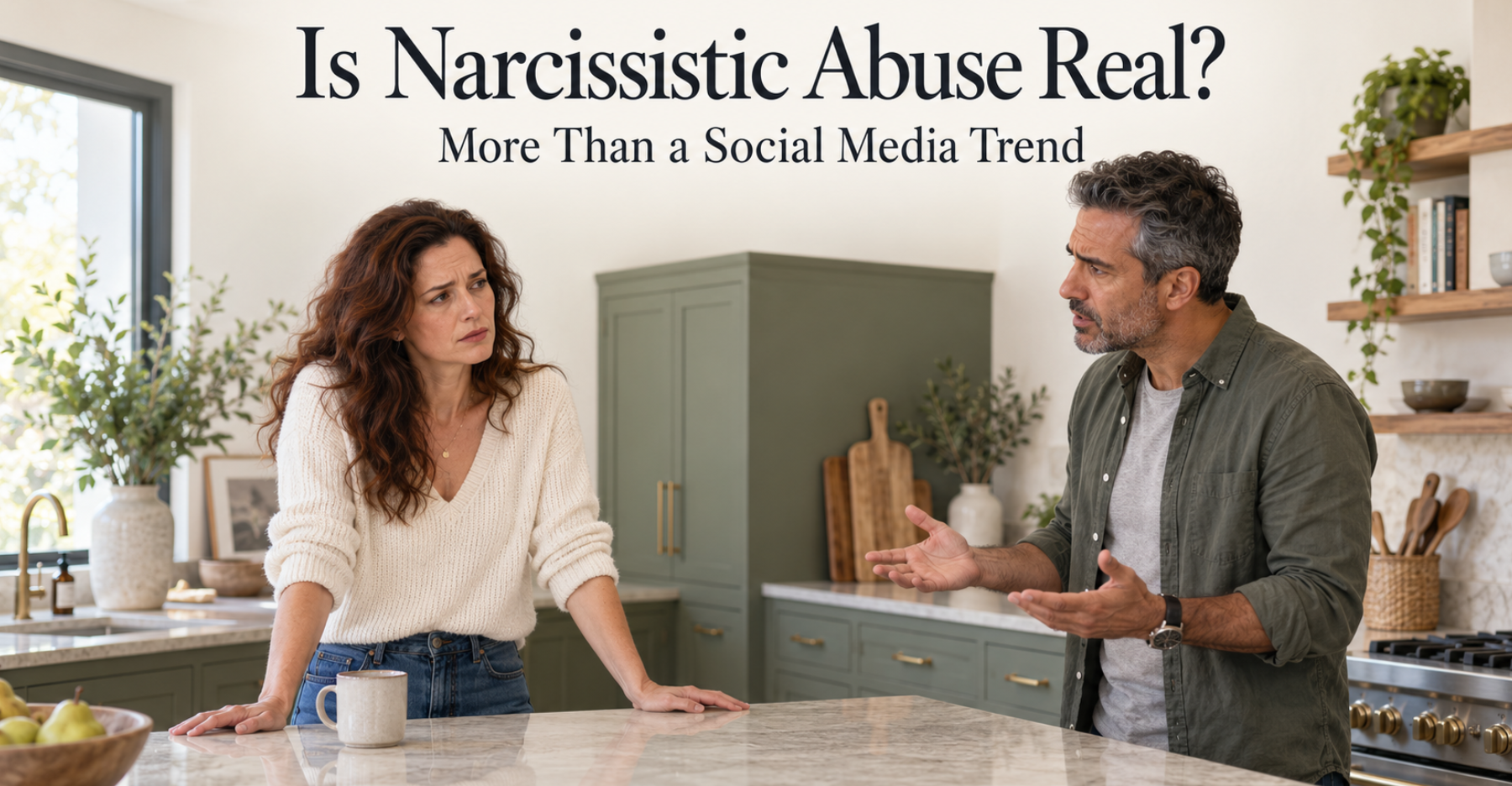
Is Narcissistic Abuse Real?
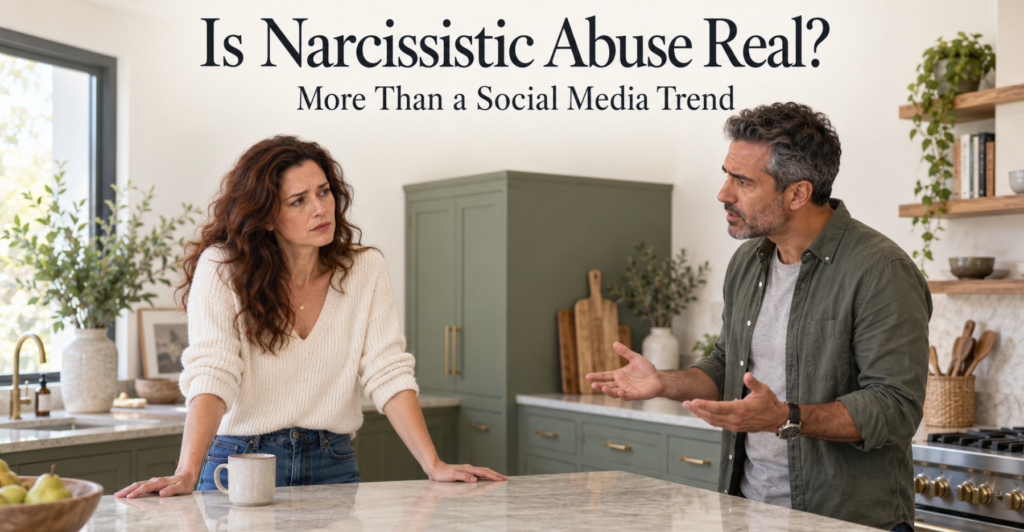
Is Narcissistic Abuse Real? Why It Is More Than a Social Media Trend
You finally find the words to describe what has been happening in your relationship.
The constant blame. Conversations that leave you questioning your memory. Feeling anxious before raising even a small concern. Being hurt, then somehow ending up apologising.
You read about narcissistic abuse and recognise parts of your own experience. For the first time, something starts to make sense.
Then someone says:
“Everyone calls their ex a narcissist these days.”
Perhaps they mean that the word is overused. What you hear is that your experience is being dismissed before you have even explained it.
If you have been searching “is narcissistic abuse real?”, you may need more than a definition. You may be looking for reassurance that the behaviour you experienced matters—and that you are allowed to seek support.
The emotional and psychological abuse people describe using this term can be very real and deeply damaging. Its seriousness does not depend on whether their partner has a diagnosis.
What do people mean by narcissistic abuse?
People often use “narcissistic abuse” to describe a relationship involving manipulation, humiliation, gaslighting, entitlement and control.
It is helpful to distinguish those behaviours from narcissistic personality disorder. Narcissistic traits, a clinical diagnosis and abusive behaviour are not interchangeable. Someone can be abusive without having narcissistic personality disorder, and a diagnosis does not automatically mean someone abuses their partner. The Hotline
You do not need to establish a diagnosis to talk about what happened.
You can say:
“My partner repeatedly humiliates me.”
“I feel frightened to disagree.”
“They deny things that happened and tell me I cannot trust my memory.”
Those experiences deserve attention in their own right.
Why dismissing narcissistic abuse can hurt
Someone experiencing emotional abuse may already spend a great deal of time questioning themselves.
“Am I too sensitive?”
“Did I explain it badly?”
“Maybe it really was my fault.”
When another person dismisses the subject as a trend, it can deepen that uncertainty. You may stop talking, withdraw a request for help or decide that your experience is not serious enough.
Emotional abuse can involve intimidation, isolation, monitoring, humiliation and manipulation. Over time, it can undermine confidence and self-worth, even without physical violence. The National Domestic Violence Hotline
The popularity of a word does not make the experiences described by it imaginary.
We can use language carefully while still listening compassionately.
When you start losing trust in yourself
One of the most unsettling experiences is noticing how much you have changed.
Perhaps you used to speak freely. Now you rehearse ordinary conversations, searching for words that will not provoke a reaction.
You may ask friends whether a reasonable request sounds selfish. You might apologise before explaining how you feel, or abandon the conversation because defending your experience seems exhausting.
Gaslighting involves behaviour that repeatedly undermines someone’s confidence in their perceptions or memories. It can leave a person confused and increasingly dependent on their partner’s version of events. The National Domestic Violence Hotline
A disagreement about what happened does not, by itself, establish gaslighting. The wider pattern matters.
Can you express a different recollection without being ridiculed? Is there room for your feelings? Does your partner ever take responsibility, or does every concern become evidence that something is wrong with you?
“But they can be so loving”
You may have warm memories alongside painful ones.
Your partner might be attentive after an upsetting incident. They may apologise, make promises or remind you of the closeness you once shared.
Those moments can make your experience harder to explain. You may think:
“If it were really abuse, surely it would feel terrible all the time?”
You are allowed to recognise affection and still take harmful behaviour seriously. A loving evening does not resolve repeated humiliation, threats or control.
Look at what happens over time. Do apologies lead to sustained changes? Can you raise concerns without consequences? Are you becoming more comfortable being yourself, or increasingly careful about everything you do?
Recognising the pattern without getting trapped in the label
If you are asking “is narcissistic abuse real?”, another useful question is:
“What is happening in this relationship, and how is it affecting me?”
Consider:
- Whether you can disagree without fear.
- Whether your friendships, privacy and independence are respected.
- Whether you are regularly blamed for someone else’s hurtful behaviour.
- Whether your concerns receive consideration.
- Whether you feel free to make everyday choices.
You do not need to win an argument about the word “narcissist” before seeking help.
In individual counseling with Nicola Beer, there is space to describe your experience, explore its impact and consider what you need next.
How to begin rebuilding clarity and confidence
1. Describe specific behaviour
When it is safe and private to do so, write down what happened, how you felt and what followed.
For example:
“I raised a concern about money. My partner insulted me, refused to discuss it and later said the argument was entirely my fault.”
Specific examples can help you explain the pattern without feeling you must prove a diagnosis. If your devices or belongings are monitored, consider discussing events privately with a professional instead.
2. Reconnect with someone who can listen
Choose a trusted person who can hear your experience without immediately judging you or directing your decisions.
You might begin:
“There are things happening in my relationship that I have found difficult to talk about. I need someone to listen.”
You do not have to tell the whole story at once.
3. Notice what you need
When you have spent a long time managing someone else’s reactions, your own needs can become difficult to recognise.
Ask yourself:
“What helps me feel settled?”
“What have I stopped doing because I worry about their response?”
“What would respectful treatment look like to me?”
Small decisions made for yourself can help you reconnect with your preferences and judgment.
4. Explore boundaries with support
Boundaries are about the treatment you can accept and the choices available to you. They cannot guarantee that another person will behave respectfully.
If setting a limit leads to intimidation or retaliation, you do not have to keep confronting the behaviour alone. Individual support can help you consider options that fit your circumstances.
5. Give recovery room
You may understand a pattern intellectually before you feel confident again.
Support can include exploring self-blame, rebuilding trust in your judgment and finding ways to settle when you feel overwhelmed. Depending on your needs, this may involve talking, grounding exercises or gentle body-based practices.
There is no requirement to recover on someone else’s timetable.
What if you are unsure whether to stay?
You may still love your partner. You may share children, finances and years of history. You may want change while feeling uncertain whether meaningful change is possible.
You do not have to minimise the harm to acknowledge those attachments.
For people searching for relationship counseling in Dubai, individual sessions can provide a starting point for discussing what is happening. Where fear, coercion or control is present, the suitability of joint sessions needs careful consideration.
If separation is something you are exploring, my divorce and separation support offers space to consider your feelings and decisions. You do not need to have decided to leave before asking for support.
Support for emotional abuse and relationship distress
I’m Nicola Beer, a relationship counsellor with more than 15 years of experience supporting individuals and couples through difficult relationship experiences, betrayal and emotional distress.
I offer individual counseling in Dubai and online support for clients in Abu Dhabi and internationally. Sessions provide a confidential space to explore your experience and begin rebuilding clarity and self-worth.
My marriage and relationship counseling services also support relationship difficulties where working together is appropriate.
Is narcissistic abuse real? The harmful behaviours and emotional suffering people describe are real, even when the label needs clarification.
You deserve to be heard without having to prove that your pain is serious enough.
Book your session with Nicola Beer for individual counseling in Dubai or online relationship support in Abu Dhabi and worldwide.