Contact Nicola today for more information about her counseling
Nicola Beer
Home
Couple
Marriage & RelationshipAffair Recovery CounselingIntimacy & SexCouple Retreat
Individual
Individual CounselingRelationship AnxietyBreak up SupportDivorce Counseling DubaiDepression Counseling
More
Reviews Blog Podcast
Book Your Session Call Us: +971 509454 233
← All articlesThe journal · Nicola Beer

Why Women Cheat Versus Why Men Cheat

25 November 2026 · 9 min read


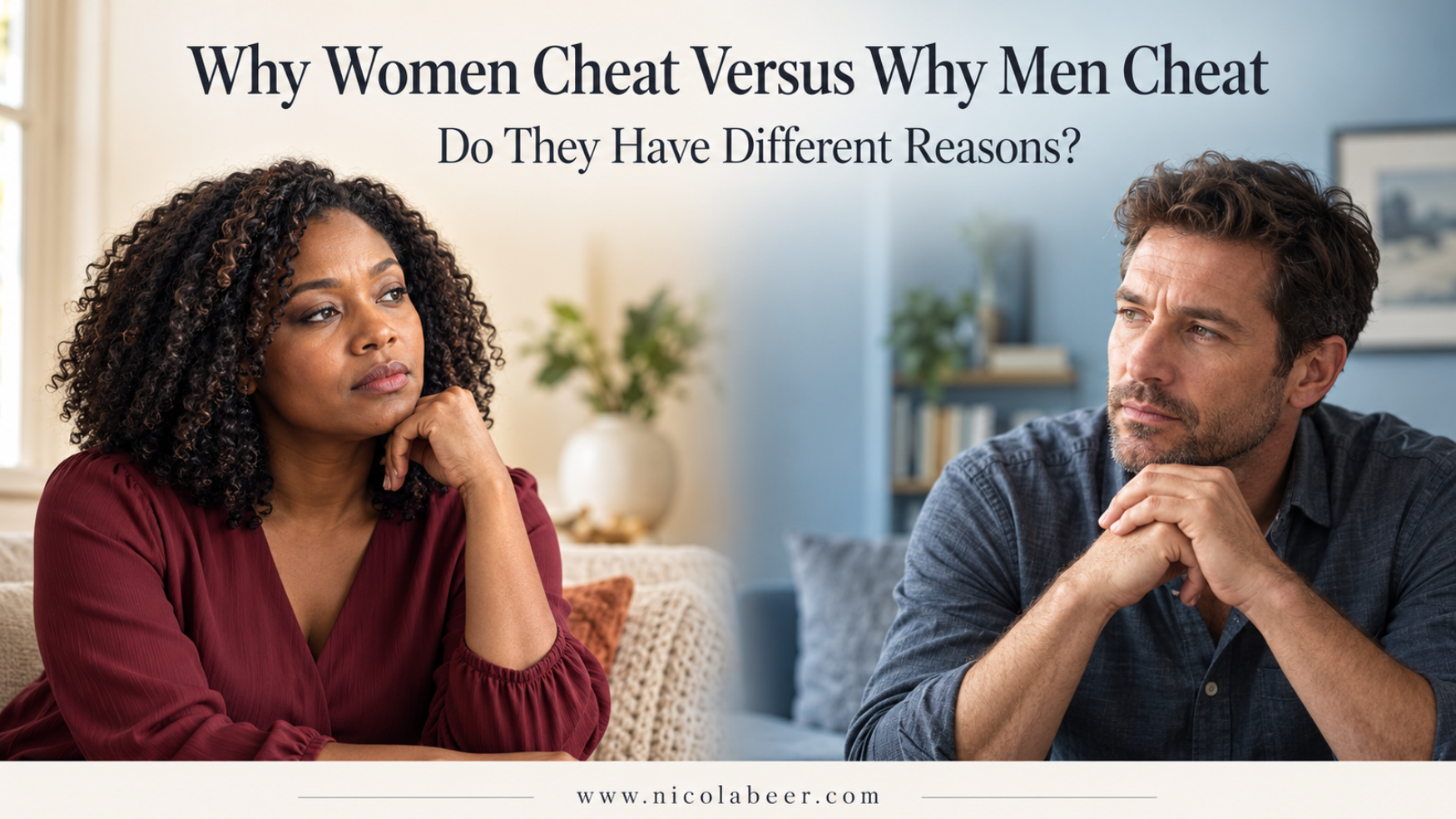
Why Women Cheat Versus Why Men Cheat: Do They Have Different Reasons?

“Was it just sex?” “Did you fall in love?” “What did they give you that I didn’t?” After discovering an affair, these questions can become consuming. You want to understand what your partner was seeking—and whether the answer changes what your relationship meant to them. People often hear that men cheat for sex and women cheat for emotional connection. Research does show some average differences between men’s and women’s reported motivations. But the overlap matters: men can seek emotional closeness, and women can seek sexual excitement. In my work supporting thousands of couples, I look at both those broader patterns and the individual person. Understanding why women cheat versus why men cheat can provide context. Understanding your partner requires an honest examination of their particular choices.

What does research say about why men and women cheat?

A study by Dylan Selterman, Justin Garcia and Irene Tsapelas examined 495 people who reported having been unfaithful, most of whom were young adults. It identified eight categories of motivation: anger, sexual desire, lack of love, neglect, low commitment, self-esteem, situational factors and sexual variety. PubMed The researchers found that:
  • Men were more likely to report sexual desire, sexual variety and situational factors.
  • Women were more likely to report neglect.
The University of Maryland’s explanation of the findings emphasised that affairs can also occur in relationships that appear stable. UMD Right Now An earlier study involving 432 college students, including 120 who reported previous dating infidelity, also found an association between male gender and sexual motivations, and between female gender and relationship dissatisfaction. These were student samples, so they should not be treated as a complete picture of long-term marriages. journals.sagepub.com These findings describe tendencies, rather than rules about every husband or wife.

Why some women cheat: emotional connection and feeling seen

In my affair recovery work, some women describe feeling lonely within their relationship long before the affair began. They may feel that conversations have become practical, affection has disappeared or their partner no longer seems interested in their thoughts. Then someone listens. They ask questions, remember details and notice when she seems upset. She begins looking forward to their conversations. Sharing becomes more personal, contact becomes private, and boundaries gradually shift. She might describe the experience as: “I felt like someone could see me again.” An emotional connection can become sexual. But the sequence varies: attraction may be present from the beginning, develop alongside closeness or never lead to physical contact. Recognising loneliness helps explain what needs attention. It does not make her partner responsible for the decision to deceive.

Women also cheat for sexual reasons

Women can seek desire, novelty, pleasure and the experience of being sexually wanted. Some describe feeling disconnected from their sexuality. Others want a different sexual experience or enjoy the excitement of someone new. It would therefore be misleading to assume that a woman’s affair must have started emotionally—or that sexual motivation makes her experience unusual. When discussing why women cheat versus why men cheat, the research supports differences in emphasis. It does not support dividing people into two separate categories.

Why some men cheat: sexual desire, variety and opportunity

For some men, the motivation includes sexual excitement or a different experience. They may pursue a brief encounter, repeated paid sexual contact, sexting or an affair without initially wanting another relationship. Some tell themselves: “It’s only physical.” “I’m not leaving my wife.” “There are no feelings involved.” Those statements may explain how they justified continuing. They do not determine how much hurt their spouse experiences. An encounter can feel emotionally devastating to the betrayed partner even when the person who cheated insists it meant very little. The important questions include what boundaries were crossed, what secrecy was involved and what allowed the person to disregard the consequences.

Men also cheat for emotional connection

Men can feel lonely, unappreciated, insecure or disconnected too. In sessions, some describe an affair as a place where they felt listened to, admired or free from the fear of disappointing someone. They may seek reassurance that they are interesting, attractive or successful. A sexual encounter can also carry emotional meaning: Someone wants me. Someone thinks I matter. Equally, a man may form a deeply emotional attachment before any sexual contact happens. Assuming his affair was “just sex” can prevent the couple from understanding what actually needs to change.

Do more men cheat than women? What the statistics show

One widely cited 2018 analysis of US General Social Survey data reported that 20% of ever-married men and 13% of ever-married women said they had had sex with someone other than their spouse while married. Among ever-married respondents aged 18–29, the figures were much closer: 11% of women and 10% of men. Institute for Family Studies These are historical US self-reports about extramarital sex. They are not current worldwide or UAE rates, and they do not capture every form of online or emotional betrayal. They nevertheless illustrate two useful points: men reported more extramarital sex overall in that analysis, while the difference was not the same across age groups.

“If a man needs a woman to cheat with, shouldn’t the numbers be equal?”

I often hear this question. The number of encounters is different from the number of people breaking commitments. For example, several married men could have sexual contact with the same single woman. Each married man would be breaking his own agreement. The single woman would not necessarily be cheating on a partner herself. Paid sexual encounters provide another example. One sex worker may see multiple married clients. Her relationship status and agreements are separate from theirs. The same counting principle can work in either direction: one man could be involved with several partnered women. Affairs can also involve same-sex partners. There is no requirement for the number of unfaithful men and women to match. However, this explains how unequal rates are possible; it does not, by itself, establish the size or cause of a gender difference.

Paid sexual contact and online behaviour also matter

In affair recovery sessions, betrayal can involve more than a conventional affair. It may include sexual services at a massage establishment, paid encounters, private live sexual interactions, sexting or an ongoing emotional connection online. These experiences need to be discussed clearly. The boundaries around pornography and online interaction vary between couples, and watching recorded content is different from personally interacting with someone. Relevant questions include:
  • What did you agree was acceptable?
  • Was sexual contact or interaction concealed?
  • Was money spent secretly?
  • Did the person lie when asked?
  • Did they continue after understanding the impact on their partner?

A statistic measuring intercourse outside marriage cannot tell us how common all these other behaviours are. Through affair recovery counseling in Dubai, I help individuals and couples discuss the full experience, including forms of betrayal that can feel embarrassing or difficult to explain.

Are younger women “catching up” with men?

Some research shows a smaller gender gap among younger adults, including the historical figures above. But a close result in one age group does not prove that women’s infidelity is steadily increasing. Age, generation, relationship status, definitions of cheating and willingness to disclose can all affect comparisons. To establish a trend, we need comparable measurements over time. To explain that trend, we need further evidence.

Could dating apps and greater sexual confidence play a role?

They are reasonable possibilities to explore, rather than conclusions those statistics establish. Dating apps, messaging and social media can provide opportunities to meet people and sustain private contact. Changing attitudes may also influence people’s sexual choices and how openly they report them. However, the studies discussed here do not show that dating apps or greater sexual confidence caused a narrowing gender gap. In an individual relationship, the useful question is more specific: “What opportunities did you pursue, and what boundaries did you choose to ignore?”

What matters after you discover cheating?

Research may help you understand the broader picture. Your recovery depends on what happens between you now.

Establish what happened

You need enough honest information to understand the situation and make decisions. “Men do this” or “women need connection” cannot replace a truthful account.

Clarify what you both want

Does the person who cheated want to rebuild the relationship and accept the work involved? Does the betrayed partner want to explore that possibility? You can begin that conversation without promising an outcome.

Identify the actual motivation

Was this about attention, sexual novelty, escape, resentment, low commitment or several factors together? The explanation should help identify changes. It should not become an excuse.

Look for remorse, empathy and consistent effort

Trust can be rebuilt when both people are committed, but it requires honesty, dependable boundaries and loving actions that continue beyond the immediate crisis. Through marriage counseling in Dubai, I help couples turn intentions into practical commitments. Individual counseling can also provide space to process your own experience. Where betrayal has affected affection, desire or sexual confidence, intimacy and sex coaching offers support without pressure to reconnect before you feel ready.

Confidential affair recovery support

I’m Nicola Beer, a relationship counsellor and affair recovery specialist. In my work with thousands of couples, I have supported people facing emotional affairs, sexual affairs, sexting, paid sexual contact and repeated cheating. I offer affair recovery counseling in Dubai, couples therapy in Dubai, and online relationship support for clients in Abu Dhabi and internationally. Understanding why women cheat versus why men cheat can offer perspective. Understanding what happened in your relationship creates the starting point for deciding what comes next. Book your session with Nicola Beer for confidential individual support, marriage counseling in Dubai or online affair recovery counseling. Whatever the motivation, rebuilding requires responsibility, empathy and actions that make trust possible again.
Personal support

Take the first step

Explore individual or couples counselling with Nicola.

Book Your Session →
★★★★★✓
I am so glad l contacted Nicola , l can’t believe the difference after just l session,l managed…I am so glad l contacted Nicola , l can’t believe the difference after just l session,l managed much better, her Audio hypno therapy tapes are fantastic a least one phrase in there will stick with you )l repeated phrases from the audio tapes with every thing l was anxious about along with other suggestions from the tapes .Nicola has changed my life, so if your Anxious or in panic mode ,contact Nicola you will not regret it .Ring her now you have nothing to lose .Thankyou Nicola
★★★★★✓
Breakthrough indeed! After experiencing a devastating trauma in my life, the opportunity to work…Breakthrough indeed! After experiencing a devastating trauma in my life, the opportunity to work with Nicola came right on time.Nicola was very in tune to what I was going through. Realizing that she had such a deep understanding of what I felt was helpful in the process, but also made me feel very comfortable being open and honest about my situation. Nicola’s ability to explain the process and allow for any questions that I had also made it a very comfortable process and allowed me to keep an open mind about our sessions.I definitely recommend for anyone dealing with trauma in their life to give this process a chance. I’ve noticed such a difference that I look forward to referring Nicola to a few close friends of mine.
★★★★★✓
My experience of seeing Nicola as a life coach was truly transformative. The guidance, support, and…My experience of seeing Nicola as a life coach was truly transformative. The guidance, support, and tools provided by my coach helped me unlock my potential, redefine my goals, and create a life that aligns with my values and passions. If you are seeking positive change, personal growth, and a greater sense of fulfillment, I wholeheartedly recommend working Nicola as a life coach.
★★★★★✓
I have worked with Nicola for some time now and have found her to be compassionate, kind, and…I have worked with Nicola for some time now and have found her to be compassionate, kind, and extremely helpful. She has helped me a lot.
★★★★★✓
Nicola is a wonderful human ? Thank you for helping me through my difficult time.Still living by…Nicola is a wonderful human ? Thank you for helping me through my difficult time.Still living by your words and advice. I would definitely recommend anyone needing relationship counseling to try Nicola 🙂
★★★★★✓
Nicola’s approach in life and career coaching has been incredible. Personal and personable, she…Nicola’s approach in life and career coaching has been incredible. Personal and personable, she makes you feel listened to and provides easy to follow advice. Thank you Nicola!
About

Nicola Beer is a Certified Counselor in Dubai, trauma-informed therapist, and internationally recognised relationship counsellor and affair recovery expert.

With over 20 years of experience, Nicola helps individuals and couples navigate relationship challenges including marriage difficulties, breakup support, divorce, emotional disconnection, and rebuilding trust after infidelity. She supports clients in strengthening their relationships—with themselves, their partners, and their families.

If you are seeking relationship counselling, marriage counselling, couples therapy, anxiety counselling, or depression counselling, Nicola offers a safe, confidential, and non-judgmental space to support your healing and personal growth.

Her specialist services are available in Dubai, Abu Dhabi, Saudi Arabia, and worldwide through online counselling. Nicola also offers private couples retreats for deeper relationship healing and transformation.

Areas of expertise include couples therapy, affair recovery, breakup support, divorce counselling, relationship anxiety, intrusive thoughts, trauma including CPTSD, childhood trauma, and sexual and betrayal trauma.

Tune in to Nicola’s podcast for insights on relationships, communication, self-esteem, infidelity recovery, jealousy, emotional healing, and reconnection.

Book Your Session